Active vs Passive LED Cooling What Is the Difference?

Time:2026-10-29 Author:Aria
0%

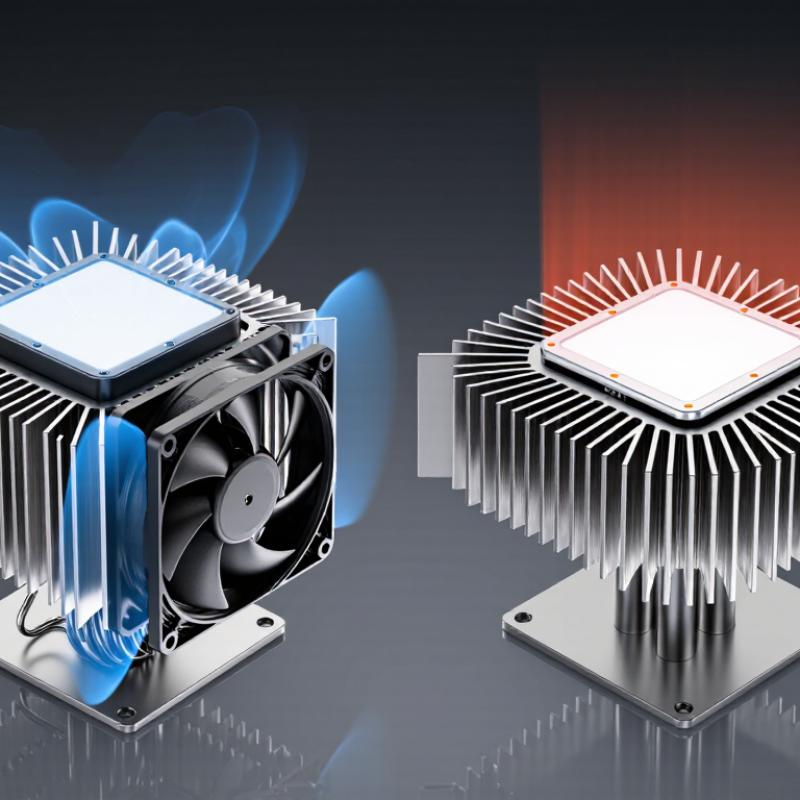
LEDs convert much of their electrical input into light, but they still produce heat that must be managed. Poor thermal control can raise component temperatures and shorten a fixture’s useful life. What is the difference between active and passive LED cooling? The key distinction is how heat moves away from the LED. Active systems use powered airflow, usually from a fan, while passive systems rely on heat sinks and natural convection.

An active cooling design can move heat quickly in a compact fixture. That can help in enclosed housings or demanding installations. But fans add noise, use power, and may collect dust or need replacement. Small details matter. A quiet fan today may not stay quiet after years of operation. Passive cooling has no moving parts; fins spread heat and release it into surrounding air. It is often quieter and simpler to maintain, though it may require more space and careful airflow around the fixture.

Neither approach is automatically better. Room temperature, mounting position, dust, fixture output, and service access all affect performance. A ceiling light surrounded by insulation faces different conditions from an open workshop luminaire. Check manufacturer temperature ratings and test data, not just marketing claims. A temperature reading taken in one setup may not predict every installation. That is easy to overlook. This guide compares active and passive LED cooling, explains their trade-offs, and shows what to consider when choosing a solution. The right answer depends on the real environment, and sometimes the available specifications leave questions unanswered.
Active vs Passive LED Cooling What Is the Difference?

What LED Cooling Does and Why It Matters

LED cooling carries heat away from the LED chip and driver, helping maintain light output and component life. LEDs use less energy than incandescent lamps, but they still produce heat at the junction. A metal heat sink spreads that heat into the surrounding air. Passive cooling relies on this natural transfer, while active cooling adds moving air from a fan. In a sealed ceiling fixture, trapped warmth can matter more than room temperature.

The U.S. Department of Energy’s Energy Saver guidance says LEDs use at least 75% less energy than incandescent lighting and can last up to 25 times longer. Those are broad comparisons, not guarantees for every fixture; heat management affects real-world performance. IES LM-80 testing measures LED light-source lumen maintenance at specified temperatures, giving manufacturers a way to assess output over time. A dusty heat sink or blocked vent can undermine that careful testing. Small details matter. I have seen cooling treated as an afterthought, though a warm fixture is not automatically a failing one. Check the manufacturer’s temperature limits and leave airflow around the housing.

How Active LED Cooling Moves Heat

Active LED cooling moves heat away from the LED using powered components, usually a fan or pump. Heat travels from the LED junction through its package and circuit board into a heat sink. A fan then pushes air across the sink’s fins, carrying heat into the surrounding space. In liquid-cooled designs, a pump moves coolant through a cold plate and radiator. The heat still needs somewhere to go.

Good results depend on the whole path, not just fan speed. A temperature sensor may adjust the fan as the LED warms, while clear vents help prevent hot air from circling back. That matters. Dust, tight enclosures, or a poorly seated thermal interface can reduce heat transfer. Active cooling can support higher output in a compact fixture, but it adds noise, moving parts, and maintenance. More airflow is not always better.

Tips: Keep intake and exhaust vents clear, and check for dust buildup. Listen for changes in fan noise; they can signal wear. Compare LED temperatures under normal operating conditions, not just at startup. A design may look adequate on paper and still run hot in a cramped enclosure, so leave room for testing.

How Passive LED Cooling Dissipates Heat

Passive LED cooling moves heat without a fan. Heat travels from the LED junction through solder, the circuit board, thermal interface, and housing. Every contact adds thermal resistance. An aluminum body spreads heat, while fins provide more surface area for natural convection and radiation. Small details matter. Dust, blocked fins, or a tight ceiling cavity can slow heat loss. Passive cooling is quiet, but not effortless.

The U.S. Department of Energy’s Energy Saver guidance reports that LEDs use up to 90% less energy than incandescent bulbs. Lower energy use does not eliminate heat inside an LED module. Heat still concentrates near the junction. IES LM-80 test reports measure lumen maintenance at specified LED case temperatures, often including 55°C and 85°C. These conditions matter: a cool outer shell cannot prove a cool junction. Effective passive cooling depends on the entire thermal path, mounting orientation, and surrounding air temperature. A fin can look generous yet perform poorly if the circuit board contacts the housing unevenly. That connection is easy to overlook.

Active vs. Passive LED Cooling: How Passive Cooling Dissipates Heat

Illustrative thermal-resistance comparison. Lower thermal resistance means less temperature rise for each watt of heat.

How passive cooling works: Heat travels from the LED into a heat sink and then moves into the surrounding air through natural convection and radiation. Active cooling adds forced airflow, which can reduce thermal resistance. The values shown are illustrative model assumptions, not universal or measured product ratings; actual performance depends on the LED, heat sink, airflow, and installation.

Key Differences in Performance, Noise, and Maintenance

Active cooling uses a fan to move heat away from LED components, while passive cooling relies on a heat sink and natural airflow. In practical installations, the difference becomes clear when a fixture runs for hours in a warm, enclosed space. A fan can help control temperature under heavier thermal loads. That may support steadier light output, though results depend on the fixture’s design and ventilation.

Noise matters. A small fan may produce a soft hum in a quiet room, and dust or worn bearings can make it louder over time. Passive systems have no moving parts, so they operate silently. They still need room for air to circulate. A heat sink pressed against insulation or tucked into a cramped cavity may shed heat poorly.

Maintenance is not identical. Active fixtures may need periodic dust checks, especially in workshops or kitchens where particles collect around vents. Fan replacement can also become necessary. Passive fixtures generally need less mechanical attention, but their heat-sink surfaces should remain clear. There is a trade-off: passive cooling is simpler, yet it can require more space or limit output. Real conditions can be messy; even a well-sized heat sink may perform differently when airflow is blocked.

Active vs. Passive LED Cooling: What Is the Difference? — Key Differences in Performance, Noise, and Maintenance

Comparison Dimension Passive LED Cooling Active LED Cooling
How it works Transfers heat from the LED into a heat sink, then releases it through natural convection and radiation. Uses a powered fan or blower to move air across or through the heat sink and carry heat away.
Cooling capacity Limited by heat-sink size, surface area, airflow around the fixture, and ambient temperature. Often suitable when heat loads can be managed without forced airflow. Forced airflow can increase heat transfer and support higher heat loads or more compact designs, provided the fan and airflow path are appropriately sized.
LED temperature Can maintain suitable operating temperatures when the heat sink and installation are designed for the LED’s heat output and conditions. Can reduce heat-sink temperature under suitable conditions, but performance depends on fan operation, airflow, and the complete thermal design.
Noise Silent during normal operation because there are no cooling fans or other moving cooling parts. Produces some sound from the fan; perceived noise varies with fan type, speed, placement, and operating conditions.
Power use Does not require electrical power for cooling itself. Requires electrical power to run the fan or blower, in addition to the LED system’s power needs.
Maintenance Typically requires less cooling-system maintenance. Dust can still collect on heat-sink surfaces and reduce heat dissipation. May require cleaning of fan blades, filters, or airflow passages. Fans are moving parts and can wear or fail over time.
Design and installation Needs adequate heat-sink area and enough clearance for natural airflow; enclosed or cramped spaces can restrict cooling. Needs a suitable fan, a clear airflow path, and allowance for fan access, sound, and potential replacement.
Common trade-off Fewer moving parts and no fan noise, but greater reliance on heat-sink size and installation conditions. More airflow and design flexibility, but with fan noise, added power use, and additional maintenance considerations.
Best suited to Applications where quiet operation, simplicity, and low cooling-system maintenance are priorities and the thermal load is manageable. Applications where the heat load or space constraints call for forced airflow and fan noise and upkeep can be accommodated.

Note: Actual LED temperature and service life depend on the full thermal design, including the LED module, heat sink, thermal interface, ambient temperature, and installation. Cooling type alone does not determine performance.

Factors for Choosing an LED Cooling Method

Choosing an LED cooling method starts with the operating environment, not the fixture’s appearance. Record ambient temperature, available airflow, mounting direction, and enclosure temperature. A sealed ceiling cavity can trap heat around a heat sink. A dusty workshop can clog fan guards. Small details matter.

The U.S. Department of Energy’s 2011 report, LED Luminaire Lifetime: Recommendations for Testing and Reporting, describes LM-80 testing at set case temperatures for at least 6,000 hours; 10,000 hours is preferred. This helps compare LED package lumen maintenance under test conditions. It does not guarantee the complete luminaire’s service life. For a real installation, check the manufacturer’s thermal data and measure the hottest LED-board or case location after the fixture reaches steady operation.

Passive cooling suits many quiet, low-maintenance installations, provided the heat sink has room to shed heat. Active cooling can help when high output or a cramped housing leaves little surface area. But fans add noise, dust exposure, and another part that may need replacement. Think about access, cleaning, and the cost of downtime—not just initial performance. A tidy calculation can still miss a hot corner or blocked vent; I would verify the design in its actual mounting position before committing to a large installation.

FAQS

How does passive LED cooling work?

Heat travels from the LED junction through solder, the circuit board, a thermal interface, and the housing. No fan is used.

What do heat sink fins do?

Fins add surface area, helping heat escape through natural airflow and radiation. Dust or blocked fins can reduce their effectiveness.

Why does an LED still need cooling if it uses less energy?

LEDs can use up to 90% less energy than incandescent bulbs, but heat still concentrates near the LED junction. Lower energy use does not remove it.

What should I check before choosing a cooling method?

Note the ambient temperature, airflow, mounting direction, and enclosure temperature. A sealed ceiling cavity can trap heat.

Does a cool outer shell prove the LED junction is cool?

No. A cool housing does not confirm a cool junction. The full thermal path matters.

What can LM-80 test reports tell me?

They compare LED package lumen maintenance at specified case temperatures, often including 55°C and 85°C. Tests run for at least 6,000 hours; 10,000 is preferred.

When might active cooling be useful?

A fan can help when output is high or the housing has little room for heat sink area. It also adds noise, dust exposure, and a part that may need replacement.

How can I check whether a fixture will cool properly after installation?

Review thermal data, then measure the hottest LED-board or case location after steady operation. Check it in the actual mounting position. I might still miss a hot corner.

Conclusion

LED cooling removes heat generated during operation, helping maintain brightness, reliability, and service life. What is the difference between active and passive LED cooling? Active cooling uses powered components, such as fans, to move air across heat-producing parts and carry heat away. This can cool LEDs quickly and suit demanding applications, but it adds noise, energy use, and moving parts that may require maintenance.

Passive cooling relies on heat sinks and natural airflow to transfer heat into the surrounding environment. With no powered moving parts, it operates quietly and typically needs little upkeep, though its performance depends on the heat sink’s design, available space, and ambient conditions. Choosing between the methods means balancing cooling needs, noise limits, maintenance expectations, energy use, and installation constraints. The right approach is the one that manages heat effectively while fitting the conditions and priorities of the specific application.

Aria

Aria

Aria is a dedicated marketing professional with a deep passion for innovative strategies and a keen understanding of our company's product offerings. With a wealth of experience in the industry, Aria excels at crafting engaging content that highlights the unique features and benefits of our......