Selecting an LED driver for an industrial fixture is not a simple wattage decision. The driver controls current, protects the LEDs, and influences service life. In a factory, one poor choice can cause flicker, overheating, or repeated shutdowns. Dust, vibration, moisture, and unstable power make the decision more demanding.
This guide explains How to select an LED driver for industrial lighting using practical engineering criteria. Begin with the LED module’s required output current and voltage range. A constant-current driver is usually suitable for high-bay and floodlight applications. Check input voltage, power factor, total harmonic distortion, and efficiency. These figures affect energy use and electrical performance. A 150-watt fixture may need more capacity during startup. That detail is easy to miss.
The installation environment matters just as much. Look for suitable ingress protection, operating temperature, surge protection, and thermal control. A driver mounted above a hot production line needs a wider temperature rating than one installed in a clean warehouse. Confirm dimming compatibility, emergency-lighting requirements, and control protocols before purchasing. DALI, 0–10 V, and PWM systems do not always work interchangeably. Test them together.
Reliable selection also requires documentation. Review datasheets, wiring diagrams, test reports, warranty terms, and local compliance requirements. Established manufacturers should explain performance limits clearly. However, brand reputation alone is not enough. Real-world results depend on installation quality, ventilation, and load matching. A driver that looks efficient on paper may fail early in a poorly cooled enclosure. Recheck the assumptions. That step can prevent expensive maintenance.
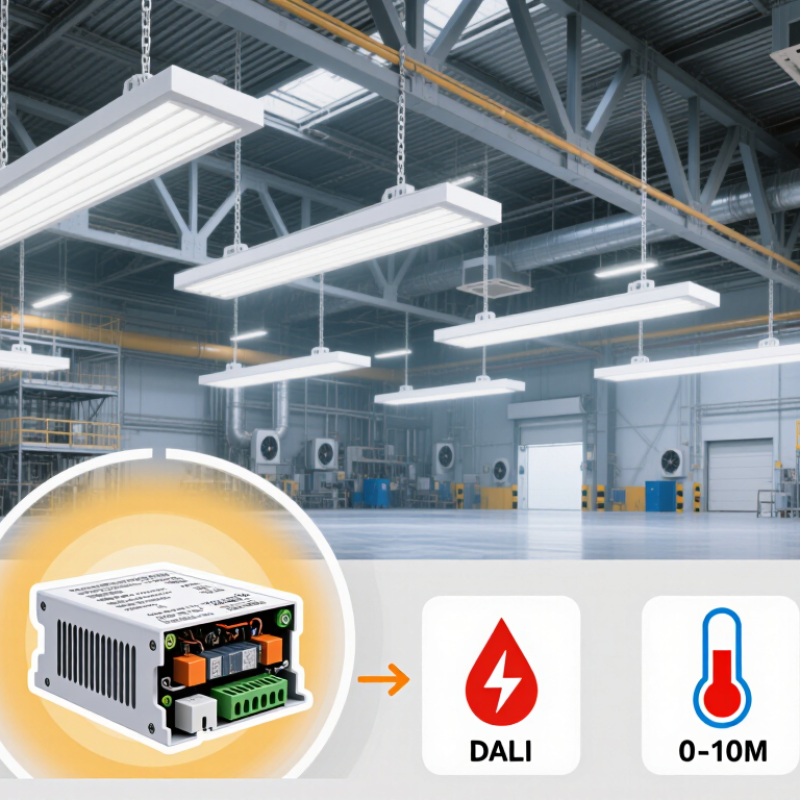
Industrial lighting begins with the correct driver type, not the highest wattage. Constant-current drivers deliver a controlled current, such as 700 mA, to LED modules designed for that value. They suit high-bay fixtures, floodlights, and other systems with LEDs connected in series. This control helps limit thermal stress and uneven brightness. However, the driver’s output-voltage range must match the LED module under real operating conditions.
Constant-voltage drivers provide a fixed output, commonly 12 V or 24 V. They work with LED strips, signs, and modules containing built-in current regulation. Connecting a constant-voltage source to bare LEDs can cause excessive current and rapid failure. It is an easy mistake. Check the wiring diagram twice.
In a factory, measure more than the rated load. Consider startup current, cable length, voltage drop, ambient temperature, and enclosure ventilation. A driver installed above a hot machine may operate differently from one tested in a cool workshop. Keep it cool. Select suitable ingress protection for dust or moisture, and verify insulation, grounding, dimming compatibility, and efficiency through technical documentation. I have seen installations pass a bench test but flicker after several hours of heat. That result deserves investigation, not guesswork. Leave reasonable power headroom, but avoid extreme oversizing, which can reduce efficiency and control quality.
How to Choose an LED Driver for Industrial Lighting?
Match Output Current, Voltage, and Wattage with 10–20% Power Headroom
Selecting an LED driver starts with the luminaire’s real electrical requirements. Check the LED module’s forward voltage, operating current, and maximum wattage. A 36-watt fixture should not use a 36-watt driver continuously. Leave 10–20% power headroom for voltage variation, heat, and aging. For example, a 36-watt load suits a driver rated near 43 watts. The driver’s output voltage range must also cover the module’s actual forward-voltage range.
Current accuracy matters in warehouses and high-bay installations. Excess current raises junction temperature and may shorten LED life. Undersized drivers can enter thermal shutdown during hot afternoons. The U.S. Department of Energy’s Solid-State Lighting R&D Opportunities report identifies thermal management and reliability as continuing industry priorities. That finding supports conservative driver sizing, not maximum-load operation.
Measure under real conditions.
A field check is worth more than a catalog estimate. Record input voltage, enclosure temperature, startup behavior, and output current after several hours. The International Energy Agency reports that lighting uses about 15% of global electricity consumption, so small efficiency losses scale quickly across industrial sites. Power factor, total harmonic distortion, dimming compatibility, and surge protection also deserve review. I have seen installations pass a bench test, then flicker beside large motors. The calculation looked correct. The environment was not. Allowing headroom helps, but it cannot replace thermal testing and electrical verification.
For industrial lighting, the driver deserves the same scrutiny as the luminaire. Verify efficiency of at least 90% at the intended load, voltage, and temperature. A 96% rating at 25°C may fall below 90% inside a hot electrical enclosure. The U.S. Department of Energy’s solid-state lighting reports emphasize thermal management as a major factor in long-term LED performance. Check measured data, not only marketing claims.
Power factor should reach 0.90 or higher under normal operating conditions. The DesignLights Consortium SSL Technical Requirements commonly use PF ≥0.90 and THD ≤20% as qualification benchmarks. Use a calibrated power analyzer at full load and during dimming. Short tests can mislead. Test every input voltage used in the facility, such as 120, 277, or 480 volts.
THD below 20% helps reduce harmonic stress on transformers, neutral conductors, and upstream protection. However, IEEE 519 evaluates distortion at the electrical system connection point, not simply at the driver output. Confirm both measurements when many fixtures share one circuit. Do not ignore standby consumption. It can affect large installations.
Ask for efficiency, PF, THD, and thermal results from an independent laboratory. The 90% target is practical, but not universal. Cold-start behavior, surge protection, and aging can change the result. Numbers without test conditions are incomplete.
Choosing an LED driver for industrial lighting requires more than checking output voltage and wattage. The enclosure rating matters in dusty, wet areas. IP65 means protection from dust and water jets. IP67 adds temporary protection against immersion. However, the driver is not the whole installation. Cable glands, connectors, and mounting orientation can weaken protection. I have seen an IP67 unit fail because water entered through an unsuitable cable entry.
Temperature performance deserves equal attention. Confirm that the driver operates from −40°C to +85°C under the actual load. Ambient temperature is not always the case temperature. A sealed enclosure can trap heat under a metal roof or inside a high-bay fixture. Check derating curves, thermal spacing, and airflow requirements. Full power may not be available at 85°C. That detail is easy to miss.
Surge rating should match the electrical environment, not just the product label. Review line-to-line and line-to-earth ratings, test standards, and pulse conditions. Outdoor poles, long cable runs, and switching equipment may produce severe transients. A higher kV figure is useful only when the test method is comparable. I once focused on nominal surge voltage and overlooked the clamping response. That was a poor comparison. Ask for test reports, grounding guidance, and replacement criteria after a surge event. Then verify the driver with the complete luminaire, because system wiring can change the result.
Assess IP65/IP67 protection, −40°C to +85°C operation, and surge rating before selecting a driver.
Dust-tight protection with protection against water jets from any direction.
Dust-tight protection with temporary immersion protection up to 1 metre for up to 30 minutes under IEC 60529 test conditions.
For harsh industrial environments, verify that the driver is rated for the required −40°C to +85°C operating range at the intended load.
The chart shows IEC 61000-4-5 combination-wave test-level references. Actual driver surge performance depends on the specified test setup, coupling mode, installation, and product certification.
Choosing an LED driver starts with the control system, not the fixture wattage. For simple zones, 0–10 V dimming is often practical and cost-effective. A separate control pair carries the dimming signal, while the driver supplies constant LED power. It works well in warehouses with basic daylight sensors or wall controls. Keep wiring polarity consistent. A small mistake can leave luminaires permanently bright.
DALI-2 suits projects needing addressable control, status feedback, and flexible grouping. It can identify individual drivers, schedule lighting scenes, and support occupancy-based operation. This is valuable in factories with changing work areas. However, installation quality matters. Confirm bus capacity, cable routing, commissioning tools, and compatibility between controllers and drivers. DALI-2 offers more control, but more control means more settings to verify.
IEC 61347 compliance should be checked through complete documentation, not a printed claim alone. Review the applicable LED-driver requirements, electrical ratings, insulation details, abnormal-condition testing, and thermal limits. Match the driver’s output current and voltage to the LED module under real ambient temperatures. In a hot ceiling space, a driver rated at 40°C may not provide the expected service life. Ask for test reports or certificates from recognized laboratories. Field experience also suggests checking standby power, flicker performance, and start-up behavior.
I once treated dimming compatibility as a minor detail; it caused uneven light during commissioning. That assumption was wrong. Test the complete fixture, control network, and emergency operating condition before approval.
Leave 10–20% headroom above the fixture’s real wattage. A 36-watt load may suit a driver rated near 43 watts. This margin helps manage heat, voltage variation, and aging.
Check forward voltage, operating current, maximum wattage, and the driver’s output voltage range. The voltage range must cover the LED module’s actual operating range. Catalog estimates can be incomplete.
Excess current increases LED junction temperature and may shorten service life. An undersized driver can shut down thermally on a hot afternoon. Conservative sizing is safer than continuous maximum loading.
Record input voltage, enclosure temperature, startup behavior, and output current after several hours. Also check power factor, harmonic distortion, dimming response, and surge protection. Measure under real conditions.
0–10 V works well for simple zones with wall controls or daylight sensors. A separate control pair carries the dimming signal. Keep wiring polarity consistent, because a small mistake may leave lights permanently bright.
DALI-2 suits projects needing addressable control, status feedback, and flexible lighting groups. It can support scenes and occupancy-based operation. More control means more settings to verify.
Test the complete fixture, controller, wiring, and emergency operating condition. Check for flicker, uneven brightness, startup delays, and failed commands. My earlier assumption was wrong.
Review electrical ratings, insulation details, abnormal-condition testing, thermal limits, and applicable test reports. Do not rely on a printed claim alone. Ask for certificates from recognized laboratories.
Large motors, hot ceiling spaces, and enclosure temperatures can change driver performance. A bench test may pass while the installed system flickers. Test it hot.
Choosing the right driver is essential for reliable, efficient industrial lighting. To understand how to select an LED driver for industrial lighting, first determine whether the fixture requires a constant-current or constant-voltage system. Match the driver’s output current, voltage, and wattage to the LED load, while allowing 10–20% power headroom to support long-term stability and prevent overheating. Electrical performance also matters: look for efficiency of at least 90%, a power factor of 0.90 or higher, and total harmonic distortion below 20%.
Industrial environments require drivers that can withstand demanding conditions. Select an enclosure rated IP65 or IP67 when protection from dust and moisture is necessary, and confirm reliable operation across temperatures from −40°C to +85°C. Check the driver’s surge protection rating, especially in areas with unstable power or outdoor exposure. Finally, choose a compatible dimming method, such as 0–10 V or DALI-2, and verify compliance with IEC 61347 safety requirements. A careful evaluation of these factors helps ensure dependable performance, energy efficiency, and easier maintenance.

Zever Light