Understanding LED Color Rendering Index (CRI) is essential for consumers. It affects our perception of colors in lighting. As illuminated spaces become crucial in daily life, the question arises: What is the CRI of an LED and why does it matter?
Renowned lighting expert Dr. Emily Gartner emphasizes, “A higher CRI value reflects true color rendition, vital for tasks requiring color accuracy.” When selecting LED lights, shoppers often prioritize efficiency, energy savings, and longevity. However, they may overlook CRI. A significant CRI ensures that colors appear vibrant and accurate.
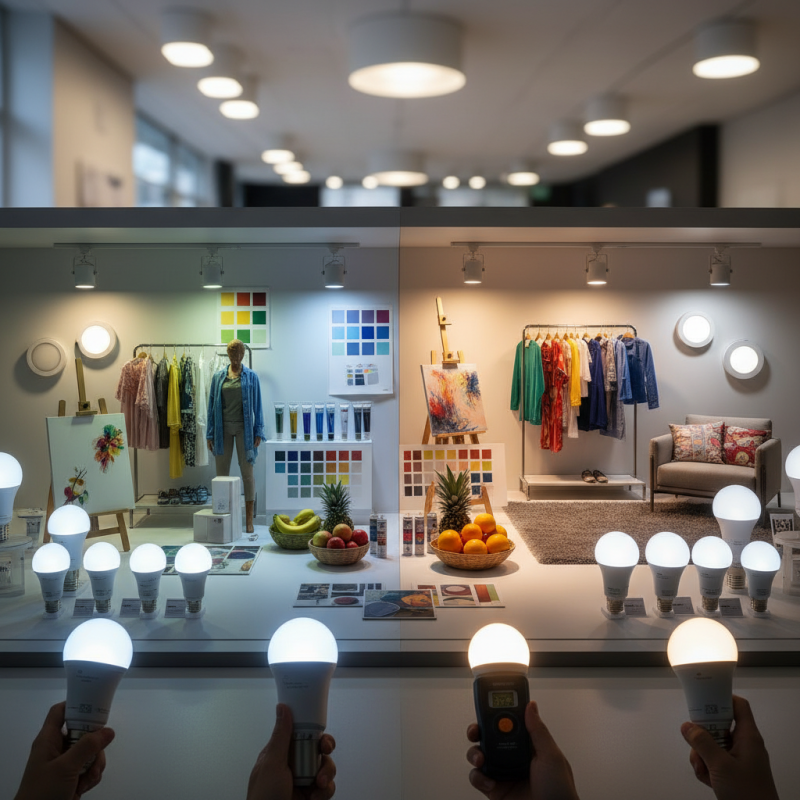
In retail, art studios, and homes, lighting plays a pivotal role. Poor CRI can distort colors, leading to misjudgments in home decor or product displays. Buyers should recognize the implications of CRI when making choices. A thoughtful approach to lighting can enhance aesthetic experiences and improve productivity in work environments.
Understanding CRI: Definition and Importance in Lighting
Understanding Color Rendering Index (CRI) is essential for anyone looking to purchase LED lighting. CRI measures a light source's ability to reproduce colors faithfully compared to natural light. A higher CRI rating indicates better color accuracy. For example, natural sunlight has a CRI of 100. A CRI score above 80 is generally acceptable for indoor lighting.
When choosing lighting, consider how it affects the appearance of colors in your space. Low CRI lights may distort colors, making them appear dull or inaccurate. This can be particularly important in settings like art studios or retail spaces, where color fidelity is crucial. In homes, the right lighting can enhance the ambiance and mood of a room.
Tips: Always check the CRI rating before buying. Aim for lights with a CRI of 90 or above for tasks that require color precision. Be aware that inexpensive LED options may have lower CRI values. It's worth looking into the specifications to avoid common mistakes in lighting choice. Testing the lights in your space can help ensure you achieve the desired effect.
The Science Behind Color Rendering Index (CRI) Explained
Color Rendering Index (CRI) is a crucial metric for lighting products. It measures how accurately a light source displays colors compared to natural light. The index ranges from 0 to 100, with higher values indicating better color fidelity. According to a study by the National Institute of Standards and Technology, a CRI of 90 or above is generally recommended for accurate color perception in settings such as galleries and retail environments.
The science behind CRI involves examining the spectral power distribution of light sources. Different light types have varying CRI scores. For instance, conventional fluorescent lights often score between 50 and 70, while LEDs can achieve scores of 95 and above. A higher CRI means that the colors of products or artworks can be perceived as intended. This matters significantly for professionals in the fields of design and visual arts.
Understanding CRI is essential for buyers looking to make informed lighting choices. Poor color rendering can lead to misinterpretation of colors in fashion and design. A CRI below 80 may skew perceptions of color, affecting decisions. Thus, relying solely on lumen output isn't enough; one must consider CRI for true visual integrity.
What is LED CRI and Why is it Important for Buyers?
| CRI Value |
Color Quality |
Common Applications |
Recommended CRI |
| 0-60 |
Poor |
General ambient lighting |
N/A |
| 61-80 |
Fair |
Retail display, office lighting |
75+ |
| 81-90 |
Good |
Residential, art galleries |
90+ |
| 91-100 |
Excellent |
Photography, color-critical applications |
95+ |
How CRI Affects Visual Perception and Color Accuracy
Color Rendering Index (CRI) is a critical measure for evaluating the true colors of objects under artificial light. It ranges from 0 to 100, with a higher score indicating better color accuracy. According to the U.S. Department of Energy, a CRI of 90 or above is ideal for high-quality illumination. This is particularly important in environments where color differentiation is vital, such as art galleries and retail spaces. Research shows that lighting with a high CRI enhances our visual perception, making objects appear more vibrant and true to life.
Lighting with low CRI can distort colors, leading to inaccuracies that may affect decision-making. For instance, a study by the Lighting Research Center found that improper lighting can cause a 30% error rate in color matching tasks. This discrepancy can impact not just aesthetic appeal but also productivity and mood in various settings. Buyers should be aware that LED lights with CRI below 80 might not adequately represent the intended colors, leading to frustration in activities requiring color precision.
Tips: Always check the CRI rating when purchasing bulbs. Consider the environment where the lights will be used. Test different lighting options before making a decision. Remember, the beauty of a space can greatly diminish under poor lighting conditions. In commercial settings, the right lighting can enhance merchandise appeal, leading to increased sales. Choose wisely.
Factors Influencing LED CRI Ratings in Products
LED Color Rendering Index (CRI) is a crucial metric for evaluating light quality in LED products. A higher CRI indicates that colors appear truer to life. Typical CRI ratings range from 0 to 100, with values above 80 considered acceptable for most applications. Factors influencing these ratings comprise the light source’s spectrum, color temperature, and the materials used in production.
Manufacturers often use different phosphors to enhance the spectrum of LED lights. This choice directly affects the CRI rating. For instance, white LEDs may have different color rendering abilities depending on their phosphor mix. Studies suggest that high-quality phosphors can increase the CRI by as much as 20 points.
Tips: Always check the CRI rating when selecting LED lights for artistic or decorative purposes. Generally, lights with a CRI of 90 or above work best for tasks that require accurate color perception. Keep in mind that even slight differences in lighting can alter the perception of color in a space, making it essential to experiment.
Another factor is the color temperature, which impacts visual perception. For example, a warm white light (around 3000K) may appear more inviting yet can distort colors compared to a neutral white. Balancing CRI with color temperature is vital for achieving the desired ambiance while ensuring colors are accurately represented.
Choosing LEDs with Optimal CRI for Your Needs
When selecting LED lights, the Color Rendering Index (CRI) is a crucial factor. A higher CRI means colors appear more vibrant and true to life. For instance, CRI values range from 0 to 100, with most quality LEDs achieving 80 or higher. According to the U.S. Department of Energy, using LEDs with a CRI of 90 or above can enhance visual tasks significantly. This is especially essential in areas like art studios and retail spaces, where precise color matching is vital.
It is important to assess your specific needs before making a choice. In living spaces, a CRI of at least 80 is often sufficient. However, if you're lighting a gallery, aim for CRI above 90. The difference in light quality can alter perceptions of color dramatically. A report from the Lighting Research Center suggests that lower CRI LEDs can distort colors. This distortion may lead to dissatisfaction or even lead to poor decision-making.
Remember that not all high-CRI lights are equal. Some may present inconsistencies in color temperature, impacting the overall ambiance. Before purchasing, consider the application and desired effect of the lighting. You might find that achieving optimal lighting requires balancing CRI, Kelvin temperature, and your environment's needs. Exploring these options can provide a more tailored lighting solution.
Understanding LED CRI Levels
This chart illustrates the Color Rendering Index (CRI) levels of various LED lighting options. A higher CRI value indicates better color accuracy when illuminating objects, making it crucial for buyers to select LEDs that meet their specific needs.
FAQS
: CRI measures how accurately a light displays colors compared to natural light.
CRI ranges from 0 to 100. Higher values indicate better color fidelity.
A CRI of 90 or above is recommended for accurate color perception in various environments.
High CRI ensures colors are seen as intended, crucial for design and visual arts.
Low CRI can distort colors, leading to misinterpretation and poor decision-making in design.
Buyers should assess CRI ratings and the intended environment for the lighting product.
Yes, improper lighting can cause inaccuracies, affecting productivity and mood.
A CRI below 80 may not accurately represent colors, leading to frustration in color-sensitive tasks.
Always check CRI ratings and test different options to find the best match for your needs.
The right lighting enhances merchandise appeal, which can lead to increased sales in commercial settings.
Conclusion
The article "What is LED CRI and Why is it Important for Buyers?" delves into the significance of the Color Rendering Index (CRI) in lighting. It defines CRI and explains its essential role in ensuring accurate color perception in various environments. Understanding the science behind CRI helps buyers appreciate how it influences visual experience and color fidelity.
Factors such as the type of light source and its spectral distribution directly impact LED CRI ratings. When considering LED products, knowing "what is the CRI of an LED and why does it matter" is critical for making informed choices that meet specific lighting needs. Selecting LEDs with an optimal CRI ensures better color accuracy and enhances the overall quality of illumination in homes, offices, and public spaces.

 Zever Light