SMD vs COB LEDs 5 Key Differences Every Buyer Should Know

Time:2026-04-29 Author:Sienna
0%

In the rapidly evolving world of LED technology, buyers often find themselves asking, "What is the difference between SMD and COB LEDs?" Industry expert Dr. Lisa Tran has been a prominent voice in this field. She once noted, "Understanding the nuances between these LED types is crucial for making informed decisions."

SMD (Surface-Mount Device) LEDs and COB (Chip on Board) LEDs each offer distinct benefits and limitations. SMD LEDs are highly favored for their versatility and compact design. They are excellent for applications where space is at a premium. On the other hand, COB LEDs provide superior light quality and efficiency. They are often chosen for larger fixtures where brightness and thermal management are priorities.

Buyer decisions should reflect specific needs and conditions. For instance, while SMDs can shine in decorative lighting, COBs are preferable for task or ambient lighting. The choice impacts energy consumption, light distribution, and lifespan. Exploring these differences helps buyers avoid potential pitfalls that may arise from selecting the wrong type for their unique projects.
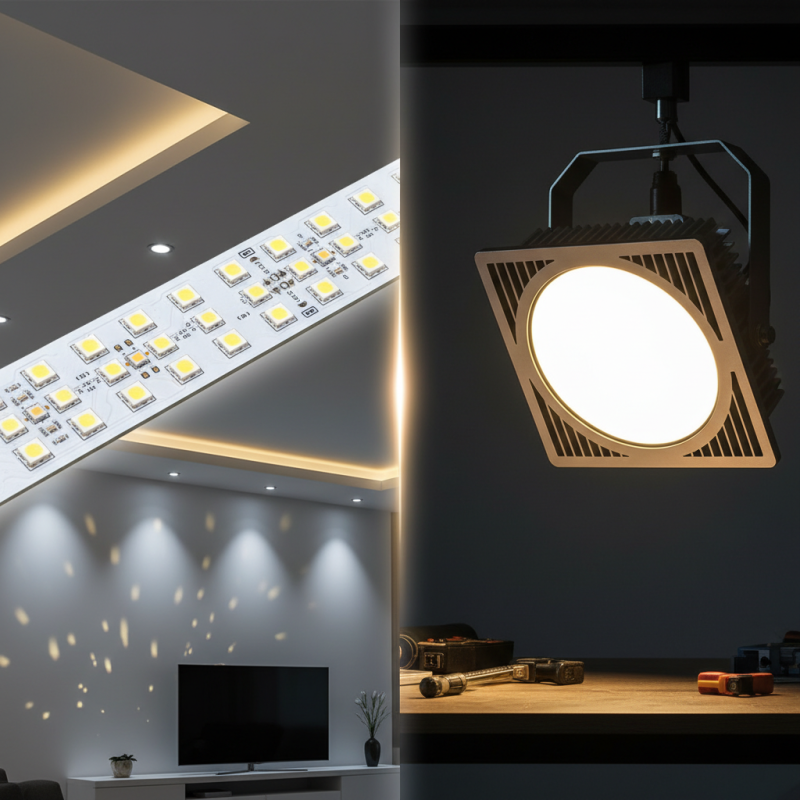
SMD vs COB LEDs 5 Key Differences Every Buyer Should Know

SMD LED Technology Overview and Applications

SMD (Surface-Mount Device) LED technology has transformed lighting solutions across various industries. Their compact size and high efficiency make them ideal for applications ranging from consumer electronics to large-scale architectural projects. According to a report by MarketsandMarkets, the SMD LED market is expected to reach USD 18 billion by 2025, highlighting a powerful trend in favor of this technology.

One key aspect of SMD LEDs is their versatility. They can produce a wide range of colors and wattages. This flexibility allows designers to create unique lighting scenarios while maintaining energy efficiency. Data from the U.S. Department of Energy indicates that LEDs, including SMDs, can save about 75% of energy compared to traditional incandescent bulbs. However, some users report challenges with compatibility in existing fixtures, necessitating careful planning during installation.

Despite their advantages, SMD LEDs can sometimes be inefficient in heat dissipation, leading to performance issues over time. It's crucial for buyers to consider thermal management solutions for longevity. SMDs also have a lower lumen output compared to COB (Chip-on-Board) LEDs, making them less suitable for high-powered applications. Its cost-effectiveness and adaptability should be weighed against these limitations, as choices vary dramatically based on specific project needs.

COB LED Technology Overview and Applications

COB LED technology stands out for its unique structure and versatility. The Chip-On-Board design allows multiple LED chips to be mounted directly on a substrate. This results in a compact light source with higher luminous output compared to other LED technologies. You will notice that the light produced is more uniform and can enhance the overall appearance of spaces.

Applications of COB LEDs are diverse and expanding. They are widely used in architectural lighting, general illumination, and stage lighting. Their ability to deliver bright, even light makes them ideal for retail spaces and galleries. However, some users report issues with heat management in high-power applications. It’s crucial to consider thermal management solutions to avoid performance degradation. Understanding the specific requirements of each project can help in making informed decisions about COB LEDs.

When selecting COB LEDs, think about your specific needs. Take into account factors like color temperature and energy efficiency. Each application may demand different specifications. Effective evaluation of these aspects will lead to better lighting solutions. Remember, what works in one scenario may not be ideal in another.

SMD vs COB LEDs 5 Key Differences Every Buyer Should Know

Feature SMD LED COB LED
Light Emitting Surface Smaller emitters with multiple chips Larger, single surface output
Heat Management Less efficient heat dissipation Superior thermal performance
Lumens per Watt Lower efficiency, typically 80-100 lm/W Higher efficiency, can reach 150 lm/W
Applications General lighting, decorative fixtures High power applications, street lights
Cost Generally lower cost Higher initial investment

Key Differences in Light Output and Efficiency

When choosing between SMD (Surface-Mount Device) and COB (Chip-on-Board) LEDs, understanding light output and efficiency is crucial. SMD LEDs typically have a higher luminous efficacy, averaging around 100 lumens per watt. In contrast, COB LEDs can reach up to 160 lumens per watt due to their integrated chips that produce light over a broader area. This makes COB better for applications requiring high intensity and uniform light distribution.

Efficiency also depends on heat management. COB LEDs excel in thermal performance, as their design allows for better heat dissipation. This can lead to a longer lifespan, often exceeding 50,000 hours compared to SMDs, which can face issues if overheating occurs. A report from the U.S. Department of Energy highlighted that LEDs overall can save up to 75% more energy than traditional lighting, but the choice between SMD and COB can affect this efficiency greatly.

Tip: Consider the environment where the LEDs will be used. For larger spaces or areas needing even lighting, COB might be preferable. However, for intricate designs with specific light angles, SMD could be ideal. Ensure to account for heat management to maximize efficiency and lifespan, regardless of your choice.

Comparison of Heat Management and Thermal Performance

When comparing SMD (Surface Mount Device) and COB (Chip On Board) LEDs, heat management plays a crucial role in performance. Effective thermal management can enhance the lifespan and efficiency of lighting solutions. According to the industry report by Strategies Unlimited, poor heat dissipation can reduce LED efficacy by over 30%. This statistic emphasizes the importance of understanding thermal performance.

SMD LEDs typically employ an array of small chips mounted on a circuit board. This design allows for some heat distribution but can often lead to hotspots. In contrast, COB LEDs integrate multiple chips on a single board. This results in better heat dissipation due to a larger surface area. Reports show that COB LEDs can operate at temperatures 10-30% cooler than typical SMD implementations. Such performance may lead to a longer lifespan and more consistent brightness.

Yet, it's important to note that not all COB solutions perform equally. Variations in manufacturing quality can affect thermal resilience. Additionally, the use of inferior thermal interface materials may lead to lower performance. Buyers should look into thorough test reports and thermal evaluations from reliable sources. Understanding these nuances can help buyers make more informed decisions.

Cost Considerations for SMD vs. COB LEDs

When considering SMD and COB LEDs, cost is a significant factor. SMD LEDs generally cost less upfront. They are widely available and suited for various applications. However, their lower price often comes at the cost of efficiency and lifespan. Buyers should weigh these factors carefully.

COB LEDs, while pricier, offer higher light output and better thermal management. They are ideal for high-performance tasks. For users willing to invest upfront, COB technology could lead to savings in energy bills and longer replacement cycles.

**Tip:** Evaluate your specific lighting needs before making a purchase. If operating in a high-use area, investing in COB might pay off.

**Tip:** Always consider the total cost of ownership. It includes initial costs, energy usage, and replacement frequency. A higher upfront cost might save money long-term.

Different applications might require different choices. For simple, short-term projects, SMD LEDs might suffice. In contrast, for installations requiring longevity and durability, COB could be the better option. Always reflect on your long-term needs.

SMD vs COB LEDs: Cost Considerations

This chart compares the average cost per LED for SMD and COB technologies. SMD LEDs tend to be more affordable than COB LEDs, with significant differences in cost impacting purchase decisions for buyers.

FAQS

: What is the main light output difference between SMD and COB LEDs?

: SMD LEDs average around 100 lumens per watt, while COB LEDs can reach up to 160 lumens per watt.

How does heat management affect LED efficiency?

COB LEDs are better at heat dissipation, leading to longer lifespans. SMD can suffer if overheated.

What should be considered when choosing LED types?

Think about the environment. COB suits larger spaces, while SMD works well for intricate designs.

Why might SMD LEDs be cheaper?

SMD LEDs have lower upfront costs, but often trade off on efficiency and lifespan.

Are COB LEDs worth the higher price?

Yes, they offer better light output and thermal management. Savings in energy bills justify the cost.

How should I assess the cost of LEDs?

Consider the total cost of ownership, including initial prices, energy usage, and replacement rates.

When are SMD LEDs a suitable choice?

For simple, short-term projects, SMD LEDs might meet your needs effectively.

What long-term factors should influence my LED choice?

Reflect on longevity and durability. COB may be better for long-term installations.

Conclusion

When considering LED technology for various applications, understanding "What is the difference between SMD and COB LEDs" is crucial. SMD (Surface Mounted Device) LEDs are known for their versatility and compact size, making them suitable for everyday lighting solutions and decorative applications. They offer a broad spectrum of colors and brightness levels. In contrast, COB (Chip-on-Board) LEDs utilize multiple LED chips mounted directly onto a substrate, resulting in higher light output and improved efficiency, making them ideal for high-intensity lighting setups such as in commercial and industrial environments.

The differences extend beyond their structure and applications; SMD LEDs typically have better heat management capabilities, while COB LEDs excel in thermal performance due to their design, which minimizes thermal resistance. Moreover, cost considerations reveal that while SMD LEDs can be more affordable initially, COB LEDs provide better value in terms of energy savings and longevity. Ultimately, the choice between SMD and COB LEDs hinges on specific project requirements, including light output, efficiency, and budget.

Sienna

Sienna

Sienna is a skilled marketing professional with a deep expertise in our company’s core products and services. With a passion for innovation and detail, she plays a pivotal role in crafting insightful blog posts that not only highlight the unique features of our offerings but also provide valuable......