Why do some LEDs change color when they get hot? The answer lies inside the tiny semiconductor chip, where heat can alter how efficiently electrical energy becomes light. In white LEDs, the blue-emitting chip and its phosphor coating may respond differently as temperature rises. The result can be a visible shift in tint, brightness, or both. Sometimes the change is subtle. Sometimes a once-crisp white lamp looks noticeably warmer or cooler.
LED researcher Nadarajah Narendran has studied how operating conditions affect LED performance. A cautious, non-verbatim summary of the relevant principle is: “Temperature-related color shifts depend on the LED’s design and how it is operated.” That distinction matters. Not every LED shifts in the same direction, and a warm lamp does not automatically mean it is failing. The driver, heat sink, optics, and phosphor all influence what reaches your eyes.
Picture an LED bulb inside a poorly ventilated ceiling fixture. Its housing grows warm, the junction inside the chip gets hotter, and its color may drift as it runs. A brief shift can differ from lasting discoloration caused by aging or component stress. Small details matter. “Hot” is not a precise measurement; case temperature and chip-junction temperature are not the same. This introduction explores the mechanisms, practical warning signs, and ways to reduce unwanted color changes—while keeping one caveat in view: without measurements, appearance alone cannot identify the cause.
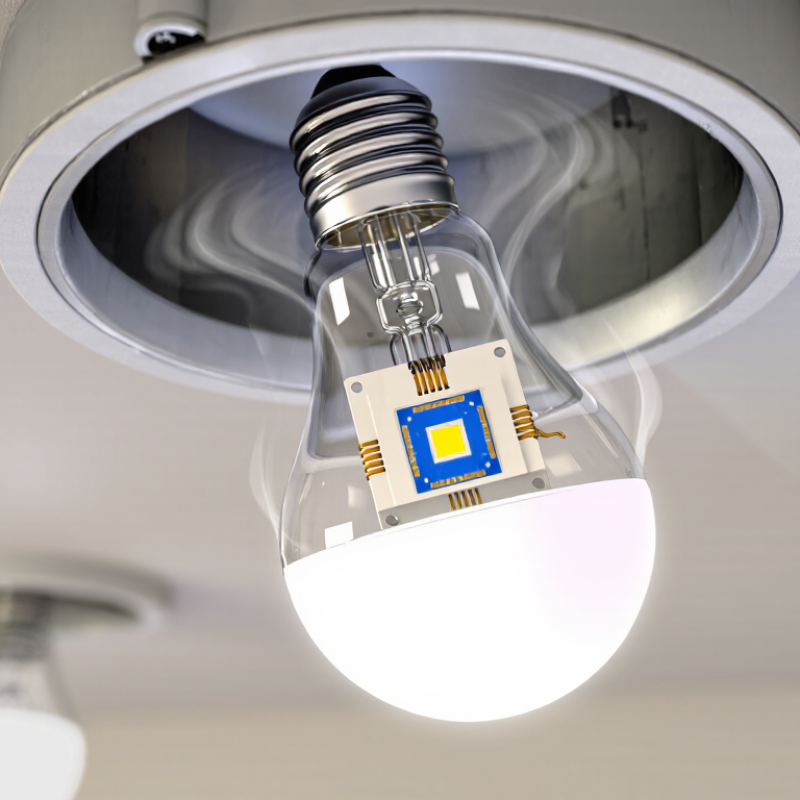
An LED’s color begins inside its semiconductor, not in a colored coating. When electric current flows, electrons and holes meet and release energy as photons. The semiconductor’s bandgap sets the energy, and therefore the wavelength, of much of that light. Different semiconductor materials produce different wavelength ranges, from deep red to blue. Tiny energy differences matter.
Heat can shift an LED’s color, but the change is usually gradual. As the semiconductor junction warms, its bandgap often narrows, nudging peak emission toward longer wavelengths. The size and direction of a visible shift depend on the device’s materials and design. In a white LED, a blue chip also excites phosphor that adds other colors. Heat may alter the chip’s output and the phosphor’s efficiency, changing the balance and making the light appear warmer or less neutral. A small color change may be hard to spot by eye. A color meter can reveal it more clearly, though readings also depend on the fixture and measurement conditions. Thermally, LEDs are not all alike; that detail is easy to overlook.
An LED’s color begins at its semiconductor junction. As that junction heats, the semiconductor bandgap generally narrows, so emitted photons carry slightly less energy and shift toward longer wavelengths. The change can be tiny. But eyes notice small color differences on a white wall or beside a cooler lamp. In phosphor-converted white LEDs, heat can also reduce phosphor efficiency, changing the balance between blue light and converted yellow light. So the visible shift may not come from the chip alone.
Temperature matters in testing, too. IES LM-80-21 specifies at least 6,000 hours of measurements for LED packages, including chromaticity maintenance, at controlled case temperatures. These are case temperatures, not direct junction readings. The distinction matters. The U.S. Department of Energy’s report LED Luminaire Reliability: Impact of Color Shift documents that color drift varies across products and operating conditions.
A warmer junction can move color, but the direction and size depend on semiconductor materials, drive current, and heat removal. That explanation is useful, but incomplete: phosphor behavior and optics can complicate what a person actually sees. A hot fixture is a clue, not a diagnosis.
A white phosphor-converted LED combines a blue chip with a phosphor layer. As the chip heats, its light output and the phosphor’s conversion efficiency can change by different amounts. The balance shifts, so the beam may look warmer, cooler, or slightly green. Small changes matter. Direct-emitting red, amber, and blue LEDs behave differently: heat can shift their emission wavelength and reduce output. In an RGB fixture, each channel responds at its own rate, nudging the mixed color away from its original setting. That drift depends on the design and operating conditions, not just the label on the box.
For useful evidence, compare measured data rather than relying on a quick visual check. IES LM-80-21 specifies measuring LED package, array, or module performance over time, including chromaticity maintenance. Its method calls for at least 6,000 hours of measurements at controlled temperatures, including 55°C and 85°C, plus a manufacturer-selected temperature. The method is valuable, but it does not predict every fixture’s behavior: heat sinking, airflow, and drive current also matter.
Tips: Let the lamp reach a stable operating temperature before judging its color. For critical lighting, record chromaticity with a calibrated meter at both cool start and steady state; note ambient temperature and airflow too. A phone camera can mislead.
Heat changes the light at its source. As an LED’s semiconductor junction warms, its bandgap changes, shifting the wavelength it emits. The shift is usually subtle, but its direction and size depend on the device. White LEDs also rely on phosphors, whose output can respond differently to temperature. The result may be a small change in color temperature or tint, not a dramatic switch.
The effect varies across LED types. In a mixed red, green, and blue system, each channel can drift by a different amount. A red channel might lose intensity faster than a blue one, nudging the combined color away from its original hue. White LEDs can appear slightly warmer, cooler, or greener depending on their construction and operating conditions. There is no single rule.
Perception complicates the picture. A warm ceiling lamp can make a nearby white LED look cooler, even when its measured output has barely changed. Our eyes adapt. So do room surfaces: a cream wall reflects light differently from a gray one. For a fair comparison, let the LED reach a stable temperature and view it beside a neutral reference. The junction itself is hotter than the outer casing, so a quick touch tells little. A spectrometer can reveal shifts that the eye misses, though I would not treat every tiny reading as meaningful in ordinary use.
LED color can shift as its junction temperature rises. In white LEDs, heat can affect the chip and phosphor differently, changing the balance of emitted wavelengths. The light may look warmer or slightly green. Small changes are visible.
Many 2026 LED designs focus on moving heat away before color drift becomes noticeable. Metal-core circuit boards, copper layers, and thermal vias carry heat from the LED package into a heat sink. A larger heat sink can help, but only when air can move around it. That detail is easy to overlook.
Some drivers reduce current when a temperature sensor detects excess heat. This can limit temperature swings, though it may also reduce brightness. Better optical and thermal testing helps manufacturers tune the package, phosphor, and driver together. Measurements after warm-up matter; a cold-start reading can miss the shift. In some fixtures, airflow or mounting still changes the result. No design removes every trade-off, and that deserves attention.
| Heat-related factor | Representative behavior | How it can affect color | Design approaches used in 2026 |
|---|---|---|---|
| LED junction temperature rises | Junction temperature increases when electrical power exceeds the package’s ability to transfer heat to the surrounding air or heat sink. | The semiconductor’s emission and the phosphor’s conversion efficiency respond differently to temperature, changing the combined spectrum. | Lower-drive operation, thermally efficient boards, well-sized heat sinks, and temperature-aware control help limit junction-temperature rise. |
| Blue-chip emission shifts | In many InGaN LEDs, the blue emission peak shifts to a longer wavelength as junction temperature rises. A commonly observed order of magnitude is a few hundredths of a nanometre per °C; the exact value depends on the LED. | A change in the blue component can alter the balance between blue light and converted light in a phosphor-converted white LED. | Designers select LEDs with characterized temperature behavior and tune the phosphor blend and operating current for the intended thermal range. |
| Phosphor conversion changes | Phosphor efficiency and spectral output can vary with temperature; the amount and direction of the change depend on phosphor chemistry and package construction. | The converted-light-to-blue-light ratio changes, which can shift correlated color temperature (CCT) and chromaticity. | Improved phosphor formulations, controlled phosphor thickness, and package designs that reduce local hot spots can improve color stability. |
| Different LED colors heat differently | In multi-channel fixtures, red, green, blue, and white LED channels can have different thermal and optical responses. | The output mix may drift as the fixture warms, even when the electrical settings remain unchanged. | Temperature sensors and channel-specific compensation can adjust drive current to maintain a more consistent color mix. |
| Optics and nearby materials warm up | Lenses, diffusers, reflectors, and encapsulants can change their optical properties or transmission with temperature. | Changes in transmission, scattering, or reflections can alter the measured spectrum and apparent color. | Thermally stable optical materials, suitable spacing, and heat paths that keep optics cooler reduce this contribution. |
| Current increases temperature | Higher drive current generally increases electrical power and heat; the relationship between current, temperature, and light output is device-specific. | Operating a fixture harder can increase thermal color drift and may also reduce light output efficiency. | Efficient drivers, appropriate current limits, and dimming strategies reduce unnecessary heat while preserving useful light output. |
| Warm-up after switch-on | LEDs and their surrounding components may take time to reach a stable operating temperature. | Color measured immediately after switch-on may differ from color measured after thermal equilibrium. | Products can be characterized after a defined stabilization period; control systems can also compensate for temperature during operation. |
| Color performance verification | CCT alone does not fully describe a color shift. Chromaticity coordinates or a color-difference measure provide additional information. | Two sources with similar CCT can still differ in tint or spectral distribution. | Thermal testing can record CCT and chromaticity at multiple operating temperatures, with limits specified for the complete fixture. |
Note: Representative behaviors and ranges are general engineering guidance, not guaranteed specifications. Actual color shift depends on LED type, package, drive current, thermal design, optics, and measurement conditions.
Its semiconductor material sets the bandgap, which influences the light’s wavelength. Electrons and holes meet, releasing energy as photons. Tiny energy differences matter.
A warmer semiconductor junction can shift its bandgap and emitted wavelength. The shift is usually gradual, not a dramatic color change. Device design matters.
Many white LEDs use a blue chip and a phosphor layer. Heat can affect the chip and phosphor differently, changing their color balance. Sometimes the difference is barely visible.
Not exactly. Direct-emitting LEDs may shift wavelength and lose output as they heat. Their behavior depends on materials and operating conditions.
Red, green, and blue channels may respond to heat at different rates. If one channel dims faster, the mixed color changes. A small imbalance can matter.
Let it reach a stable temperature, then compare it with a neutral reference. Record the room temperature and airflow. A nearby warm lamp can fool your eyes.
Not reliably. Camera settings and surrounding light can distort the result. A calibrated color meter gives clearer measurements, though setup still matters.
Not completely. Controlled tests can track color changes over thousands of hours and at set temperatures. A fixture’s heat sink, airflow, and drive current also matter. I might overread tiny differences; context counts.
Why do some LEDs change color when they get hot? The answer lies in how an LED’s semiconductor junction produces light. As current flows, electrons release energy as photons, and the materials in the junction determine the light’s characteristic color. Rising temperature can alter the junction’s electrical and optical properties, slightly changing the wavelengths produced. The result may be a visible shift in hue or a change in brightness and color balance.
Different LED types respond differently because their semiconductor materials, construction, and operating conditions vary. A shift that is subtle in one LED may be more noticeable in another, especially when the light’s output is already close to a neighboring hue. In 2026, improved thermal pathways, more stable materials, and refined driver controls help limit heat buildup and maintain consistent color. These measures cannot make temperature irrelevant, but they can reduce unwanted shifts and help LEDs deliver steadier, more predictable light.
Zever Light