Why do LEDs lose brightness over time (lumen depreciation)? The answer begins inside the LED package, where heat, materials, and electrical stress slowly reduce light output. Unlike incandescent bulbs, LEDs rarely fail suddenly. Their brightness usually declines gradually, often measured through the L70 rating. L70 indicates when an LED reaches 70% of its initial lumens.
James R. Brodrick, a recognized solid-state lighting expert associated with the U.S. Department of Energy, has stated, “LEDs do not burn out; they fade gradually over time.” That short sentence captures an important engineering difference. Excessive junction temperature can damage the semiconductor and phosphor. Poor heat sinking makes this problem worse. A dusty lens, aging driver, or restricted airflow can also reduce visible brightness.
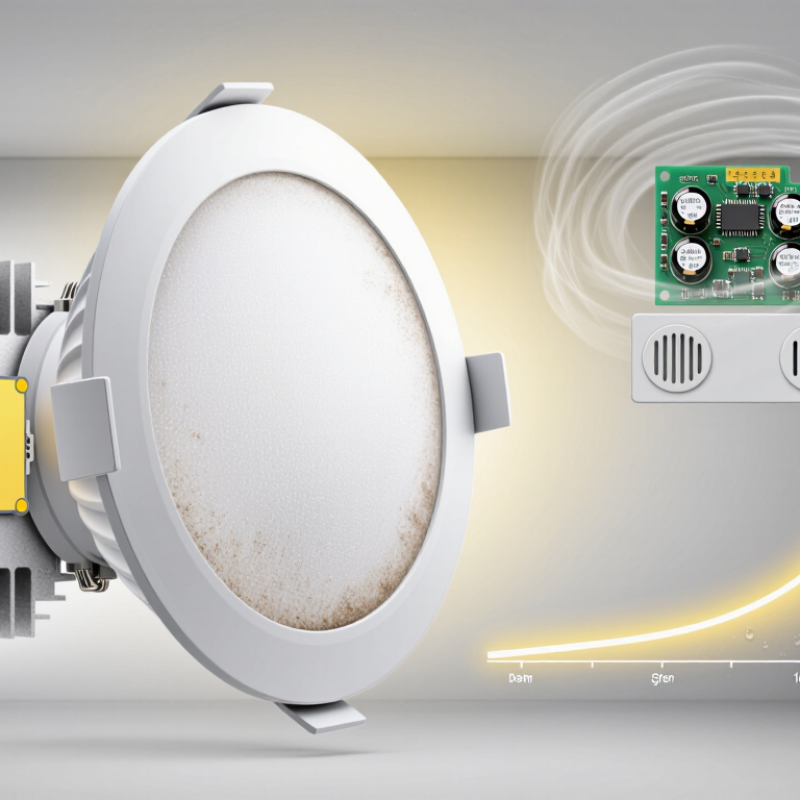
Look closely at an older LED downlight. Its aluminum body may feel unusually hot after several hours. The light can appear weaker, slightly warmer, or uneven across the room. These changes often reflect several causes working together, not one defective component.
Manufacturers test LED performance under controlled conditions, but real installations are less predictable. High ambient temperatures, frequent switching, moisture, vibration, and low-quality drivers can accelerate depreciation. Still, ratings are not promises for every environment. That deserves careful attention. Even professional explanations can oversimplify the issue.
This article examines the main causes of lumen depreciation, explains how thermal management affects lifespan, and shows what buyers should check before choosing LED products. It also questions a common assumption: longer rated life does not always mean consistent brightness.
What LED Brightness Means and How It Is Measured
Why Do LEDs Lose Brightness Over Time?
What LED Brightness Means and How It Is Measured
LED brightness is not one simple property. In everyday speech, it usually means how bright a lamp looks. Lighting engineers measure it with different quantities. Luminous flux, measured in lumens, describes the total visible light leaving the LED. Luminous intensity, measured in candelas, describes light in a particular direction. Illuminance, measured in lux, tells us how much light reaches a surface. That distinction matters.
A calibrated integrating sphere can collect light from many angles and estimate total lumens. A photometer can measure intensity or illuminance at a fixed distance. Testing should control current, temperature, optics, and warm-up time. A cool LED may appear stronger than the same LED after heating. The reading is only useful when conditions are recorded. Even then, measurement uncertainty remains. This is easy to overlook.
Over months or years, heat and electrical stress can reduce light output. Engineers often describe this decline with lumen maintenance, such as L70. L70 estimates when output reaches 70 percent of its initial measured value. It is a projection, not a promise for every installation. Dust, blocked ventilation, and high drive current can accelerate visible dimming. In practical checks, compare the lamp under the same supply, temperature, and distance. A phone camera can show change, but it cannot replace calibrated equipment. I used to treat brightness as a single number. That assumption was too simple.
Why Do LEDs Lose Brightness Over Time?
LED brightness is commonly measured as luminous flux in lumens. The chart shows normalized lumen maintenance over operating hours using an L70-style degradation profile: 70% output represents the point at which an LED is considered to have reached its useful light-output life. Actual results vary with temperature, drive current, thermal design, and operating conditions.
Brightness decreases gradually because heat, electrical stress, and material aging reduce the LED package’s light output. The values are normalized percentages of initial luminous flux and do not represent any specific manufacturer or product.
How Heat Gradually Reduces LED Light Output
Why Do LEDs Lose Brightness Over Time?
Heat is the quiet enemy of LED brightness. When current passes through an LED chip, some electrical energy becomes light, but much becomes heat. If that heat remains trapped, the junction temperature rises. Phosphors can shift, solder connections can weaken, and optical materials may darken. The lamp still works, but its output slowly fades.
The U.S. Department of Energy’s SSL research commonly describes LED lifetimes between 25,000 and 50,000 hours, depending on operating conditions. These figures usually refer to L70 performance, meaning the light output has fallen to 70% of its initial level. They are not promises for every installation. The IES LM-80 and TM-21 standards also require measured lumen maintenance under defined temperatures and currents. A cooler test does not perfectly represent a sealed ceiling fixture above a hot kitchen.
Small details matter. A dusty heat sink can raise operating temperature. Poor airflow can do the same. In field inspections, I would check the fixture housing, mounting surface, and driver temperature before blaming the LED chip. A 10°C rise may appear harmless, yet repeated heat cycles can accelerate material aging. The exact effect varies by design, so simple rules can mislead. A neat 50,000-hour claim may hide uncomfortable assumptions. Better thermal paths, lower drive currents, and ventilation usually protect brightness, though none can stop aging completely.
Why Do LEDs Lose Brightness Over Time? - How Heat Gradually Reduces LED Light Output
| Thermal Condition |
Approx. Junction Temperature |
Typical Initial Light Output |
Estimated Output After 25,000 Hours |
Main Effect on the LED |
| Excellent heat management |
45–60°C |
100% |
90–95% |
Low thermal stress and slower degradation of the phosphor and semiconductor materials. |
| Good heat management |
60–75°C |
100% |
85–92% |
Normal operating stress; gradual lumen depreciation becomes measurable over extended use. |
| Moderate heat management |
75–90°C |
100% |
75–88% |
Higher temperature accelerates material aging and can increase color shift and light-output loss. |
| Poor heat management |
90–110°C |
100% |
60–80% |
Rapid lumen depreciation, greater color instability, and increased risk of premature component failure. |
| Severe thermal stress |
Above 110°C |
100% |
Below 60–75% |
High risk of accelerated degradation, solder-joint fatigue, phosphor damage, and shortened service life. |
Note: The output percentages are representative engineering ranges, not guaranteed ratings. Actual LED performance depends on drive current, operating cycle, ambient temperature, thermal resistance, enclosure design, phosphor quality, and the specific LED package. Manufacturers commonly define useful life using lumen-maintenance targets such as L70, the time required for light output to reach 70% of its initial value.
How Electrical Stress Accelerates LED Aging
Why Do LEDs Lose Brightness Over Time?
How Electrical Stress Accelerates LED Aging
An LED usually fades because its semiconductor junction and surrounding materials slowly deteriorate. Electrical stress speeds this process. When current exceeds the rated value, even briefly, the junction produces extra heat. That heat can damage microscopic layers, weaken bond connections, and reduce light-producing efficiency. The change may be invisible at first. Months later, the same lamp can appear noticeably dimmer.
Voltage spikes create another problem. LEDs are current-sensitive devices, so a poor driver can deliver sharp surges during startup or unstable power conditions. Repeated surges encourage defect growth inside the diode. Ripple current also causes rapid heating and cooling, especially in compact fixtures with limited airflow. In bench testing, a small increase in current can produce a surprisingly large temperature rise at the junction. The housing may feel only warm.
Thermal design matters more than many users expect. Dust-covered vents, loose connections, and undersized heat sinks trap heat around the LED. A reliable evaluation measures junction temperature, operating current, ripple, and startup behavior instead of judging brightness alone. Long-duration tests can expose gradual degradation that a short inspection misses. I have also found that real installations rarely match ideal test conditions. That gap deserves more attention. A safer design leaves electrical headroom, limits surge current, and keeps the junction cool during its daily operating cycle.
How Materials and Components Degrade Inside an LED
Why Do LEDs Lose Brightness Over Time?
How Materials and Components Degrade Inside an LED
LEDs do not usually fail like old incandescent bulbs. Their brightness declines gradually through lumen depreciation. The main cause is heat trapped near the semiconductor junction. High junction temperatures can alter the light-producing materials and weaken internal connections. It is gradual.
In practical lighting inspections, heavily used fixtures often show darkened lenses or yellowed plastic. This discoloration reduces the light leaving the package. Many white LEDs use a phosphor layer to convert blue light into broader wavelengths. Over years, heat and strong optical energy can reduce the phosphor’s efficiency. Moisture and ultraviolet exposure may also cloud the encapsulant. A clean lens cannot repair damage inside the package.
The driver can age as well. Capacitors lose performance, causing unstable current or reduced power. Solder joints may expand and contract through daily heating cycles. Tiny cracks can increase electrical resistance and create more heat. That feedback loop is easy to overlook. I once treated brightness loss as a simple LED problem, but the driver explained much of the measured drop. Testing standards such as LM-80 and TM-21 help estimate long-term performance, yet real installations remain less predictable. Dust, poor ventilation, and enclosed housings change the thermal conditions. Even a carefully rated LED may age faster in a hot ceiling cavity.
How Usage Conditions Affect Long-Term LED Performance
Why Do LEDs Lose Brightness Over Time?
How Usage Conditions Affect Long-Term LED Performance
LED brightness declines mainly through lumen depreciation, not sudden failure. Heat is often the main cause. In a poorly ventilated fixture, internal temperatures can rise quickly. A ceiling light above an insulated room may trap heat around its circuit board. That stress gradually affects the LED chip, phosphor layer, and power components. Cooler operation usually preserves light output for longer.
Usage patterns also matter. An LED running twelve hours daily experiences more thermal cycles than one used occasionally. Frequent switching can stress the driver, especially when power quality is unstable. Dimmers must match the light’s electrical design. An unsuitable dimmer may cause flickering, buzzing, or extra heat. Dust makes matters worse. A blocked heat sink cannot release warmth efficiently.
Moisture and vibration deserve attention. In damp areas, corrosion may develop around electrical connections, even when the lamp still appears normal. Outdoor fixtures need proper protection ratings and sealed connections. In practical inspections, I would measure temperature near the housing, check voltage stability, and compare brightness with a new unit. Visual judgment alone is unreliable. The room may seem bright enough.
Not every dim LED has reached the end of its useful life. A dirty cover or aging driver can create similar symptoms. Manufacturers’ lifetime estimates also depend on controlled conditions, not every household. That limitation matters. I have seen installations fail earlier than expected because heat was treated as an afterthought. Better airflow, correct controls, and regular cleaning can slow the decline, though they cannot stop material aging completely.
Conclusion
Why do LEDs lose brightness over time (lumen depreciation)? LED brightness refers to the amount of visible light produced, commonly measured in lumens. Although LEDs are highly efficient and long-lasting, their light output gradually declines as internal materials and components age. Heat is one of the main causes because excessive temperature can weaken the light-emitting materials, protective layers, and surrounding components. Electrical stress, such as operating above recommended current or experiencing unstable power, can accelerate this aging process and reduce efficiency.
The materials inside an LED may slowly degrade, causing less light to be generated or transmitted. Other factors, including poor ventilation, high ambient temperatures, dust, humidity, frequent switching, and extended operating hours, can also affect long-term performance. Proper thermal management, stable electrical conditions, suitable installation, and reasonable usage can help slow lumen depreciation and maintain more consistent brightness throughout the LED’s service life.

 Zever Light