Why are UV LEDs becoming popular for disinfection? The answer begins with a practical problem: microbes can persist on air, water, and frequently touched surfaces. In its 2022 Global Report on Infection Prevention and Control, the World Health Organization estimated that 7 in 100 patients in high-income countries acquire at least one healthcare-associated infection. The estimate rises to 15 in 100 in low- and middle-income countries. These figures strengthen demand for additional, measurable hygiene controls.
UV LEDs produce ultraviolet-C radiation without mercury, offer compact designs, and can switch on instantly. Their small size supports installation inside air cleaners, water systems, and handheld equipment. They also allow manufacturers to control exposure more precisely through sensors and timed cycles. The U.S. Department of Energy’s solid-state lighting research identifies UV-C LED efficiency, thermal management, and lifetime as continuing development priorities. The technology is promising, but it is not magic. A useful system still requires the correct wavelength, delivered dose, exposure time, and maintenance plan.
A cautious reader should pause. Safety matters.
The International Commission on Non-Ionizing Radiation Protection and standards such as ISO 15858 emphasize controlling human exposure to UV-C radiation. In real installations, dust, distance, airflow, and shadowed surfaces can reduce performance. Industry testing should therefore verify irradiance and microbial reduction under actual operating conditions, not only laboratory conditions. UV LEDs are becoming popular because they combine design flexibility with growing public-health pressure. Yet responsible adoption depends on independent validation, transparent specifications, and realistic claims. That balance is sometimes missing in marketing.
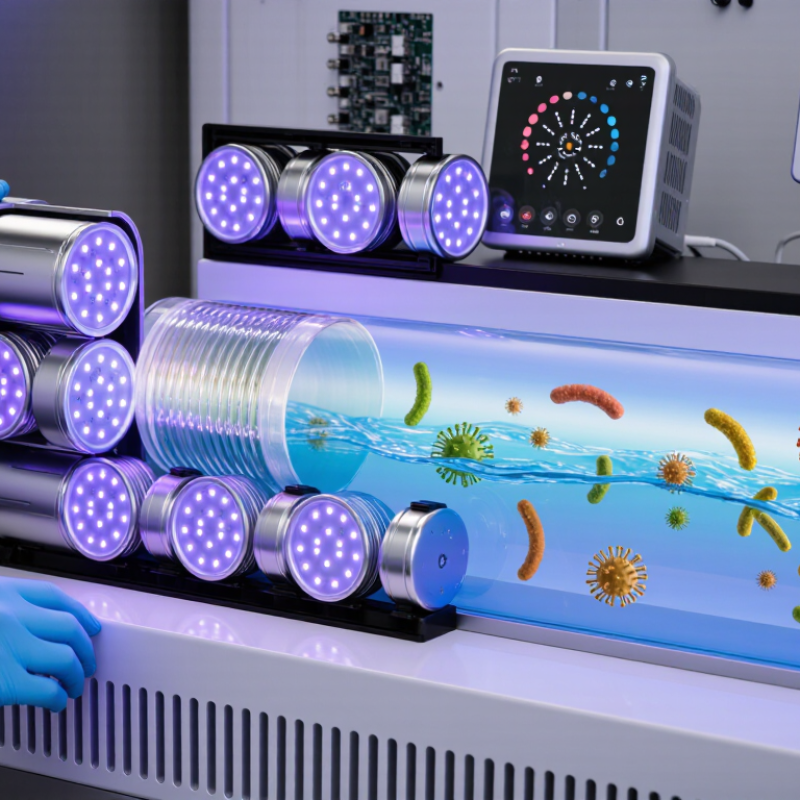
UV LEDs are compact semiconductor devices that emit ultraviolet light. Many disinfection systems use UVC wavelengths, commonly between 200 and 280 nanometers. Unlike visible light, UVC can disrupt the nucleic acids of bacteria, viruses, and other microorganisms. This damage can stop them from reproducing. The process is physical. An LED array directs energy toward water, air, or a nearby surface. Disinfection depends on dose, which combines light intensity and exposure time. A brighter lamp does not always mean better treatment. Distance, angle, dust, and shadows can reduce delivered energy. Shadows matter.
In practical testing, a clean surface may receive enough UVC, while a hidden edge receives far less. Airflow also matters because particles may pass through the treatment zone too quickly. Reliable equipment therefore needs measured output, controlled exposure, and routine inspection. Sensors can identify declining performance, but sensor readings still require proper interpretation. Safety cannot be treated as an afterthought. Direct UVC exposure can injure eyes and skin, so shielding, interlocks, and careful maintenance are essential. Some materials also degrade after repeated exposure. Hands-on inspections often reveal that simple assumptions fail. A clean-looking chamber may still contain shadowed areas. Independent testing and application-specific validation help confirm whether a system achieves its stated microbial reduction under real conditions.
UV LEDs are gaining popularity in disinfection because they offer compact, targeted ultraviolet output. Their small size allows engineers to place them inside air ducts, water channels, inspection tools, and enclosed equipment. They start instantly, unlike lamps that may need warm-up time. They also contain no mercury, which can simplify handling and end-of-life planning. This matters in clinics, food-processing areas, laboratories, and public facilities where space and maintenance time are limited. Small footprint. Practical advantage.
In real installations, performance depends on more than turning on a UV source. The selected wavelength, optical design, exposure time, and surface distance must match the microorganism and application. LEDs can switch rapidly, enabling sensors to adjust operation when water flow or air movement changes. Their directional output may reduce wasted energy, although poor positioning can create untreated zones. Independent testing, calibrated radiometers, and documented dose targets make claims more trustworthy. A bright light is not proof of disinfection.
UV LED systems also support modular maintenance. Failed emitters can sometimes be isolated, while monitoring electronics can record operating hours and output decline. However, efficiency, heat management, and service life remain important engineering challenges. In a dusty enclosure, optical surfaces may lose performance sooner than expected. That detail is easy to overlook. Safety controls are essential because direct UV exposure can harm skin and eyes. I would not treat every LED device as equally effective; verified data and regular validation still matter.
UV-C LEDs are gaining attention because they combine compact design, rapid electronic control, mercury-free construction, and flexible wavelength selection. The figures below are representative engineering ranges; actual disinfection performance depends on delivered UV-C dose, irradiance, exposure time, target microorganism, distance, airflow or water quality, and system design.
| Evaluation Dimension | UV-C LEDs | Low-Pressure Mercury UV Lamps | Why It Matters for Disinfection |
|---|---|---|---|
| Typical Germicidal Wavelength | Approximately 260–280 nm, with wavelength selected according to the LED design. | Approximately 253.7 nm, a strong germicidal emission line. | Both wavelength ranges can damage microbial DNA or RNA. The most suitable wavelength depends on the application and target organism. |
| Warm-Up Time | Effectively instantaneous; UV output can begin when electrical power is applied. | Typically requires a warm-up period, often from several seconds to several minutes depending on lamp and ballast design. | Fast startup supports on-demand treatment, short operating cycles, and responsive automated systems. |
| Switching and Dimming | Electronic switching is straightforward, and output can commonly be controlled through drive current or pulse-width modulation. | Frequent switching can reduce lamp life, while dimming is more limited and depends on the ballast. | Flexible control can help systems deliver the required dose while reducing unnecessary energy use. |
| Typical Service Life | Often approximately 10,000–30,000 operating hours, depending on drive current, thermal management, and required output level. | Commonly approximately 8,000–12,000 operating hours, with UV output gradually declining over time. | Longer service intervals can reduce maintenance, replacement labor, and downtime. |
| Electrical-to-UV-C Efficiency | Commercial devices commonly fall within a broad range of approximately 3%–8%, although performance varies by wavelength and operating conditions. | Low-pressure systems commonly convert approximately 25%–35% of electrical input into UV-C radiation. | Mercury lamps can be more electrically efficient, while LEDs may offer system-level advantages through precise control, reduced losses, and targeted illumination. |
| Mercury Content | Contains no mercury. | Contains a small quantity of mercury that requires controlled handling and disposal. | Mercury-free construction supports simpler end-of-life management and helps address hazardous-material concerns. |
| Physical Size and Form Factor | Compact solid-state packages can be arranged in small, modular, or customized arrays. | Usually requires a tube, electrodes, ballast, protective housing, and sufficient installation space. | Compact modules make it easier to integrate UV-C into air ducts, water channels, appliances, sensors, and portable equipment. |
| Mechanical Durability | Solid-state construction has no glass tube or internal electrodes and generally offers strong resistance to vibration and shock. | Glass tubes and internal components are more vulnerable to breakage and mechanical shock. | Greater durability can be valuable in mobile equipment, vehicles, industrial machinery, and compact consumer systems. |
| Optical and Wavelength Design | Arrays, lenses, reflectors, and multiple wavelength options can be incorporated into the system design. | Emission is largely determined by the lamp chemistry and lamp geometry. | Optical flexibility can improve irradiance distribution and help designers match the source to air, water, or surface-treatment conditions. |
| Thermal Management | Requires effective heat removal, usually through a conductive heat path, heat sink, or other thermal design. | Produces heat and may require ventilation, spacing, or temperature control around the lamp and ballast. | Temperature control is essential because excessive heat can reduce UV output and shorten component life in either technology. |
| Maintenance Requirements | Typically involves cleaning optical surfaces, checking output, and inspecting the driver and thermal interface. | Requires lamp replacement, cleaning, ballast inspection, and safe management of broken or spent lamps. | Lower replacement frequency and simpler maintenance can reduce total operating effort. |
| Best-Fit Applications | Point-of-use water treatment, air-handling equipment, surface modules, portable devices, sensors, and systems requiring rapid control. | Large-scale water and air treatment installations where high UV-C efficiency and continuous operation are priorities. | UV-C LEDs are especially attractive where space, switching, modularity, or mercury-free operation is more important than peak source efficiency. |
| Key Limitation | Higher device cost per unit of UV-C output and strong dependence on thermal design and current control. | Limited switching flexibility, larger form factor, mercury handling requirements, and gradual output degradation. | The preferred technology should be selected using delivered dose, lifecycle cost, safety, maintenance, and environmental requirements rather than source type alone. |
Important safety note: UV-C radiation can injure skin and eyes. Disinfection equipment should be enclosed or interlocked where necessary, and system performance should be verified by measuring irradiance and delivered dose.
Data basis: Representative ranges compiled from commonly reported UV-C LED and low-pressure mercury-lamp engineering characteristics. Actual values vary by device, operating current, ballast or driver, optical design, temperature, and aging.
UV LEDs are becoming popular because their advantages fit modern disinfection equipment. They are compact, mercury-free, and switch on instantly. Their narrow beam can target air, water, or a small surface with less wasted energy. UV-C wavelengths near 265–280 nanometers are widely studied for microbial inactivation. The International Ultraviolet Association states that performance depends on wavelength, dose, exposure time, and surface conditions. This matters in real rooms. Dust, shadows, and rough plastic can reduce delivered UV energy.
The U.S. Department of Energy’s 2023 Solid-State Lighting R&D Opportunities report identifies UV-C LED efficiency and output as key research priorities. That is an important reality check. UV LEDs offer precise control, but they are not automatically more efficient in every device. Thermal management remains necessary because heat can reduce output and shorten operating life. A properly designed system can also provide instant cycling, lower maintenance, and flexible installation in compact ducts or handheld enclosures. Field testing often reveals uneven coverage.
Tips: Ask for verified irradiance data, not only rated LED power. Check the measured dose at the farthest point. Replace damaged optics quickly. Keep safety interlocks active. Avoid judging performance from wavelength alone; validated dose is the practical benchmark. The U.S. EPA’s UV Disinfection Guidance Manual emphasizes validated dose delivery, while ASHRAE guidance stresses airflow, exposure time, and maintenance. Small details matter. Temperature, distance, and surface geometry can change results.
UV LEDs are used in many focused disinfection settings. In water systems, they treat drinking water, laboratory water, and wastewater streams. Their compact size supports installation inside pipes, dispensers, and small treatment chambers. Operators can switch them on instantly, without waiting for warm-up. However, performance depends on UV-C dose, water clarity, flow rate, and exposure time.
Air treatment is another growing application. UV LEDs can be installed in ventilation equipment, air purifiers, and enclosed circulation units. They help reduce microorganisms that pass through the treatment zone. Surface disinfection also appears in healthcare rooms, food preparation areas, public transport, and shared equipment.
Shadows, dirt, and uneven surfaces can reduce results. One missed corner matters. Distance matters.
Tips: Choose equipment with verified dose data and clear maintenance instructions. Keep lenses and protective covers clean. Use sensors or service checks when consistent output is important. Never expose skin or eyes to active germicidal UV-C. A practical review should examine airflow, surface geometry, and operating time, not only LED power.
UV LEDs are promising, but they are not magic. Installation errors still require honest reflection.
UV-C LEDs are gaining attention because they are compact, mercury-free, and easy to control. Their output can target germicidal wavelengths, commonly between 260 and 280 nanometers. However, disinfection is never determined by wavelength alone. A 2023 ASHRAE Handbook chapter links performance to irradiance, exposure time, airflow, surface distance, and maintenance. Published studies often report microbial reductions from 90% to over 99.9%, but results depend heavily on dose and test conditions.
Safety requires strict control of direct and reflected UV-C exposure. The ICNIRP ultraviolet guidelines set wavelength-dependent exposure limits for skin and eyes. IEC 62471 also provides a framework for evaluating photobiological risks from optical radiation. In real installations, shields, door interlocks, motion sensors, warning labels, and automatic shutoff systems should work together. A clean lens proves little. Dust, biofilm, and aging LEDs can reduce delivered dose while the equipment still appears normal.
Ozone generation deserves attention when emissions extend below approximately 240 nanometers. Thermal management also matters because excessive heat can reduce LED output and shorten service life. Operators should verify irradiance with calibrated instruments, not rely only on rated power. The 2022 International Ultraviolet Association guidance emphasizes validation under actual operating conditions. That is where many designs become less certain. Shadows, uneven airflow, and forgotten maintenance can leave untreated areas, even when laboratory tests look excellent.
UV LEDs are compact semiconductor devices that emit ultraviolet light. Many disinfection systems use UVC wavelengths from 200 to 280 nanometers.
UVC light damages the nucleic acids of microorganisms. This can stop them from reproducing. The process is physical, not chemical.
Performance depends on dose, combining light intensity and exposure time. Distance, angle, dust, shadows, water clarity, and airflow also affect results.
No. A brighter lamp may still perform poorly with short exposure or poor positioning. A hidden edge can receive much less energy.
They are used in water systems, air treatment equipment, ventilation units, and enclosed circulation devices. Surface applications include rooms, food areas, transport spaces, and shared equipment.
Their compact size fits pipes, dispensers, and small chambers. They also switch on instantly without warm-up. That is convenient, but convenience is not proof of performance.
Direct UVC exposure can injure eyes and skin. Shielding, interlocks, and careful maintenance are essential. Keep people away from active, unprotected light.
Keep lenses and protective covers clean. Check output with sensors or service inspections. Sensors help, but their readings still need proper interpretation.
Look for verified dose data and application-specific testing. Review airflow, surface shape, operating time, and microbial reduction. A clean-looking chamber may still hide shadowed areas.
Dirt, shadows, uneven surfaces, and fast airflow can reduce delivered energy. Some materials may degrade after repeated exposure. UV LEDs are promising, not magic.
Why are UV LEDs becoming popular for disinfection? UV LEDs are compact semiconductor devices that emit ultraviolet light, especially wavelengths capable of damaging the genetic material of microorganisms and preventing them from reproducing. Unlike chemical disinfectants, they can treat air, water, and exposed surfaces without leaving chemical residues. Their small size, low energy consumption, rapid start-up, and flexible design make them attractive for modern disinfection systems.
UV LEDs are used in water purification equipment, air treatment units, surface-disinfection devices, and portable or integrated systems. Their long service life and controllable operation also support efficient, automated applications. However, effective disinfection depends on factors such as wavelength, light intensity, exposure time, distance, surface cleanliness, and system design. Safety is equally important: direct exposure to UV light can harm the eyes and skin, so shielding, interlocks, warning labels, and proper operating procedures are essential. With responsible design and use, UV LEDs offer a practical, efficient, and chemical-free approach to reducing microbial contamination.

Zever Light